
Abdominal Wall Hernias
Abdominal wall hernias occur when an organ or fatty tissue protrudes through a weak spot in the abdominal muscles. This condition can lead to discomfort and serious health risks if left untreated. Understanding the types of hernias, their symptoms, diagnosis, treatment options, and the role of surgery is crucial for patients. Inguinal hernia commonly presents as a bulge in the groin area, while umbilical hernia appears near the navel and may become more noticeable during strain or coughing.
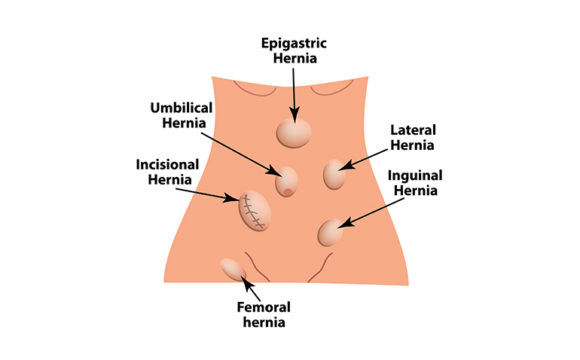
Types of Abdominal Wall Hernias
Common Types of Abdominal Wall Hernias
-
Inguinal Hernia
- Description: Occurs when tissue (usually part of the intestine) protrudes through a weak spot in the lower abdominal wall or into the inguinal canal.
- Common in: Men more than women.
-
Femoral Hernia
- Description: Occurs when tissue protrudes through the femoral canal, located just below the inguinal ligament.
- Common in: Women, particularly those who are pregnant or obese.
-
Umbilical Hernia
- Description: Occurs when tissue bulges through the abdominal wall near the belly button (umbilicus).
- Common in: Infants and children, but can also occur in adults, often associated with obesity or pregnancy.
-
Incisional Hernia
- Description: Develops at the site of a previous surgical incision, where the abdominal wall has weakened.
- Common in: Patients who have undergone abdominal surgeries, especially if there were complications like infection.
-
Epigastric Hernia
- Description: Occurs when fatty tissue or part of the intestine protrudes through the abdominal wall in the upper abdomen, between the breastbone and the navel.
- Symptoms: Usually asymptomatic, but may cause localized pain.
-
Spigelian Hernia
- Description: A rare type of hernia that occurs through the Spigelian fascia, located along the edge of the rectus abdominis muscle.
- Symptoms: May present with localized abdominal pain.
-
Hiatal Hernia
- Description: Occurs when part of the stomach pushes through the diaphragm into the chest cavity.
- Symptoms: Often associated with gastroesophageal reflux disease (GERD).
Symptoms of Abdominal Wall Hernias
Patients with abdominal wall hernias may experience a variety of symptoms, which can vary based on the type and severity of the hernia. Common symptoms include:
- Visible Bulge: A noticeable lump or bulge in the affected area (e.g., groin for inguinal hernias).
- Pain or Discomfort: Often described as a sharp or aching sensation, particularly with activities that increase abdominal pressure (coughing, heavy lifting).
- Heavy or Full Sensation: A feeling of fullness in the abdomen or affected region.
- Nausea or Vomiting: May occur, especially if the hernia becomes incarcerated or strangulated.
- Changes in Bowel Habits: Such as constipation or inability to pass stool if there is obstruction.
Diagnosis of abdominal wall hernias includes:
- Physical Examination:
- The healthcare provider inspects the abdomen for any visible bulges, palpates for defects, and assesses symptoms.
- Imaging Studies:
- Ultrasound: Useful for identifying hernias and evaluating size and contents.
- CT Scan: Provides detailed images for complex hernias, especially in adults.
- MRI: May be used in cases where ultrasound and CT are inconclusive.
- Confirmatory Tests:
- In some instances, additional testing may help identify the extent of the hernia or any associated complications.
Surgical intervention may be recommended for abdominal wall hernias under the following circumstances:
- Pain or Discomfort: Persistent symptoms that interfere with daily activities.
- Complications: Such as incarceration (where the hernia becomes trapped) or strangulation (where the blood supply to the trapped tissue is compromised), both of which require immediate surgical attention.
- Size Increase: When the hernia grows or becomes more prominent over time.
- Wanting to Prevent Future Problems: Patients may opt for surgery to avoid potential complications.
- Open Surgery
- Description: The traditional approach involves a larger incision to directly access the hernia.
- Indications: Used for larger hernias or those with complications.
- Laparoscopic Surgery
- Description: A minimally invasive technique using several small incisions and a camera (laparoscope) to repair the hernia.
- Benefits:
- Reduced postoperative pain.
- Shorter recovery time.
- Smaller incisions leading to less scarring.
Inguinal Hernias
Overview
Inguinal hernias are the most common type of abdominal wall hernia. They occur when a portion of the intestine or fatty tissue protrudes through the inguinal canal, a passage in the lower abdominal wall. This condition is more prevalent in men and can lead to discomfort and complications if left untreated.
Patients with inguinal hernias may experience the following symptoms:
- Visible Bulge: A noticeable lump in the groin or scrotal area, which may become more prominent when standing or during physical activities.
- Pain or Discomfort: Often described as a dull ache or sharp pain in the groin, especially when lifting, bending over, or coughing.
- Burning Sensation: A feeling of burning or heaviness in the groin area.
- Nausea or Vomiting: Associated symptoms may occur, particularly in cases of incarceration or strangulation.
The diagnosis of an inguinal hernia typically involves the following steps:
- Physical Examination:
- A healthcare provider will palpate the groin area to look for a bulge, assess the size of the hernia, and evaluate any associated discomfort or pain.
- Imaging Studies:
- If an inguinal hernia is not immediately evident, imaging such as ultrasound or CT scan may be performed to confirm the diagnosis and assess the extent of the hernia.
Surgery for inguinal hernias is generally recommended under the following circumstances:
- Pain or Discomfort: Patients experiencing persistent pain or discomfort in the groin area.
- Size Increase: If the hernia enlarges or changes in appearance.
- Symptoms of Incarceration or Strangulation: Emergency surgical intervention is required if the hernia becomes trapped or if the blood supply to the herniated tissue is compromised.
Surgical Techniques for Inguinal Hernia Repair
There are two primary laparoscopic approaches for inguinal hernia repair:
- Technique Overview:
- A laparoscope is inserted through small incisions in the abdomen.
- The peritoneum (the lining of the abdominal cavity) is entered to access the abdominal wall defects.
- A mesh is placed over the hernia defect to provide support and prevent recurrence.
- Benefits:
- Offers good visualization of the hernia and surrounding structures.
- Allows for the repair of bilateral hernias if needed in one setting.
- Technique Overview:
- A laparoscope is inserted through small incisions, with the surgeon working entirely outside the peritoneum via the extraperitoneal space.
- The hernia is repaired by placing a mesh in the preperitoneal space, covering the defect without entering the abdominal cavity.
- Benefits of TEP:
- Reduced Risk of Intra-Abdominal Complications: By avoiding entry into the peritoneal cavity, there’s a lower risk of injuring intra-abdominal organs.
- Less Postoperative Pain: Patients generally report reduced postoperative discomfort compared to TAPP.
- Shorter Recovery Time: Many patients experience a quicker recovery and can return to normal activities sooner than with open surgery.
- Immediate Postoperative Care:
- Patients typically remain in the recovery area for monitoring of vital signs and assessment for complications.
- Hospital Stay:
- The patient is typically discharged from hospital on the same day as the surgery or the following day, depending on their recovery progress.
- Diet and Activity:
- Patients can start clear liquids shortly after the procedure and progress to a regular diet as tolerated.
- Light activity can usually be resumed quickly, while strenuous activities should be avoided for 4 weeks.
- Common Risks:
- General Surgical Risks: Include risks associated with any surgery, such as infection, bleeding, and complications related to anesthesia.
- Specific Complications for Inguinal Hernia Surgery:
- Recurrence of the Hernia: While laparoscopic repairs generally have low recurrence rates, they remain a possibility.
- Nerve Injury: There is a risk of damaging nerves in the groin, which can lead to chronic pain or numbness.
- Infection: Infections may occur at the incision sites or within the surgical mesh.
- Hematoma: A localized collection of blood can occur at the surgical site, leading to swelling and discomfort.
- Seroma: This is an accumulation of clear fluid in the surgical area that may require drainage.